

Resilience through access
The UK is at a pinch point in the journey towards a more cyber resilient future, with threats changing face and tactic by the day; private and public sector organisations are struggling to adapt and protect.
However, the urgency couldn’t be clearer. The National Cyber Security Centre has revealed that the UK experiences four nationally significant cyber incidents every week – all of which pose a major threat to the economy and public infrastructure. [1]And it’s no wonder. The explosion of digital innovation in the last decade has opened up unparalleled opportunity, but has also increased the attack surface, giving cyber criminals the platform to stage nationally catastrophic cyber-attacks.
But a silent assassin amongst UK threats are Distributed Denial of Service (DDoS) attacks. These attacks are a national concern, not just a corporate one, with the potential to knock out access to essential public digital services, and private platforms alike. That has material impact on the economy, the citizen experience and industry integrity – with the potential to disrupt worldwide supply chains, such as the effects seen after the Jaguar Land Rover attack.
Globally, DDoS incidents have grown in attack volume by more than 350%, with more attacks recorded in h1 of 2025 than all of 2024[2]. This explosion opens a question of whether existing security measures are adequate, and how technological advancements offer protection against both the growing scale and volume of DDoS attacks from bad actors.
To protect basic infrastructure from such threats, policy, inclusion, and innovation need to be at the forefront of this conversation.
Evolving face of DDoS attacks
One-off, high-volume events designed to knock over systems for a prolonged period have evolved into multi-vector campaigns that are:
- Harder to detect
- Harder to mitigate
- Easier than ever to stage
One evolving case study that we are seeing is the rise of the Botnet Aisuru.
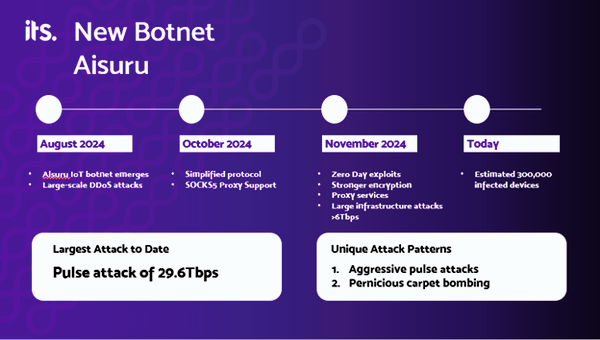
The access to AI generated ambushes has made it easier for bad actors to stage destructive attacks like the Aisuru botnet. With automated reconnaissance resulting in faster detection of network weaknesses, it’s now possible to generate adaptive attack patterns to shift and evade detection in real-time.
That means not only has the technicality of DDoS attacks shifted, but the faces behind them. Threat actors are now not only advanced cyber criminals, but they can also be disgruntled customers, students, and amateur hacktivist groups.
Compounding this are attacks that are outpacing traditional centralised defences that rely on ‘known’ attacks. Now, Zero-Day attacks, carpet bombing and b0t-net staged attacks are making it difficult for organisations to keep up. And that is the best-case scenario. In some cases, DDoS attacks mask devastating ransomware attacks that have the potential to knock out critical national infrastructure or entire business supply chains.
The result: shared exposure across the UK’s entire digital ecosystem. SMEs, councils, and public bodies are now facing the same complex DDoS threats as multinational enterprises.
The old mode no longer works
For too long, effective DDoS mitigation has been a privilege, not a standard. Traditional solutions have been complex to deploy, costly to maintain, and prone to performance trade-offs – leaving many smaller businesses and public sector organisations exposed.
Schools, councils, and SMEs have often faced an impossible choice: protect their networks at unsustainable cost, or accept a level of risk that would never be tolerated by larger enterprises.
In today’s threat environment, that model is untenable.
This inequality in access to protection doesn’t just endanger individual companies – it creates systemic vulnerability across the UK’s connected economy, where disruption to a single user cascades through entire supply chains and essential services.
Democratising DDoS protection at the edge
A new generation of distributed, edge-based security models is changing how organisations defend themselves. By using advanced machine learning, these systems can identify and mitigate malicious traffic closer to its source, before it ever reaches the target.
Unlike traditional, centralised scrubbing approaches, edge intelligence solutions scale equitably – providing rapid, automated protection for organisations of every size, without the latency or cost once associated with advanced defence.
This marks a fundamental shift in mindset: from reactive, isolated protection to proactive, collaborative defence that strengthens the UK’s digital ecosystem. It is a transformation enabled by industry partnerships, open innovation, and advances in AI-driven detection, making enterprise-grade protection a shared capability, not a luxury.
Ultimately, it closes a chapter on latency-riddled scrubbing centres with metallic tiering that forces organisations to compromise.
A Shared Responsibility for a Secure Digital Economy
Cyber resilience is essential for critical national infrastructure, underpinning every part of the UK’s connected economy. Democratised access to advanced protection ensures that local authorities, public services, and businesses can continue to operate confidently, even as attacks grow in scale and sophistication.
Delivering that resilience demands shared responsibility: a coordinated effort between government, technology providers, and the private sector. Initiatives such as ITS SecureEdge, built in collaboration with leading security partners, show how innovative, scalable approaches can make enterprise-grade protection accessible to all – helping build a stronger, more secure